03 · Research
Research
Legislator communication, election administration, and affective polarization.
Dissertation
Timely Talk: Responsive Legislator Communication
University of California, San Diego
When do legislators respond to their constituencies? In this three-paper
dissertation I use the public communications of legislators to investigate
how changes in the constituency and the country motivate members of
Congress to adapt how they present themselves to the public. In the first
paper, I pair congressional press-release and Census data to measure the
effect of changes in constituency demographics on what legislators talk
about, finding some evidence that legislators adapt their communications in
response to changes in electoral safety and the size of certain demographic
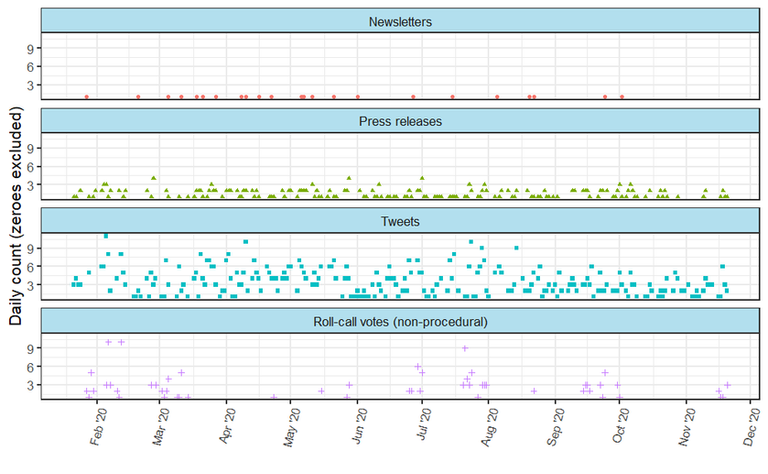
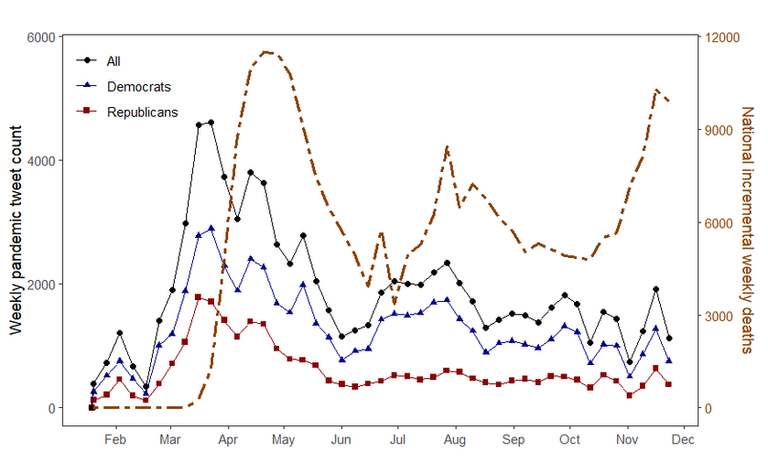
groups in their constituency. In the second paper, I leverage the COVID-19
pandemic to test for legislators’ responsiveness to local and national
conditions in their social media posts cross-sectionally and longitudinally,
finding mixed evidence of responsiveness to constituency conditions. In the
third paper, I consider how the nationalization of on- and offline media
impacts legislators’ attention to local and national topics in their
social media posts and press releases. Together, these studies contribute
to literatures concerning legislator responsiveness and political
communication by moving beyond traditional methods of measuring
legislators’ activities in favor of using text-as-data methods to
measure how legislators present themselves to the public and represent
their constituents.
Working paper
Out-party Governance and Affective Polarization: Warming Up to the Other Side
with Jen Gaudette
Pairing observational data with a nationally fielded YouGov survey, we
investigate the effect of exposure to out-party governance and nonpartisan
elections at the local and state level on affective polarization.
Working paper
Reading Up or Rolling Off? Voter Guide Content and Voter Engagement in Ballot Measure Elections
with Joseph Loffredo, Mason Reece, Honor Durham, Aamuktha Kottapalli, Erin Parker, Sina Shaikh, Ning Soong, Rachel Wright, and Charles Stewart III · MIT Election Data and Science Lab
Ballot measure elections pose something of a paradox for voter engagement.
Measures can drive turnout when highly salient, but they also impose higher
information costs than other contests. This is both because the underlying
policies can be complex and because measures lack the candidate names, party
labels, and other cues voters ordinarily rely on. States seek to blunt these
costs by producing official voter guides containing ballot language, neutral
summaries, fiscal impact statements, and arguments for and against. Surveys
find that the majority of voters who receive a guide do use them when
deciding how to vote. Do guides successfully lower the informational cost of
voting on ballot measures? We pair a novel dataset of official voter guides
containing 4,813 measures in 22 states from 1908 to 2025 with roll-off data
for those same measures. We measure the complexity of each measure, the
complexity of the associated content in the voter guide, and its effect on
roll-off. We expect more complex measures to increase roll-off, but a
simpler guide will moderate this effect. Our results contribute to work
studying direct democracy, how voters get informed, and electoral
institutions. Our data also make it possible to address questions about the
influence of interest groups in ballot measure contests or the neutrality of
official summaries.